
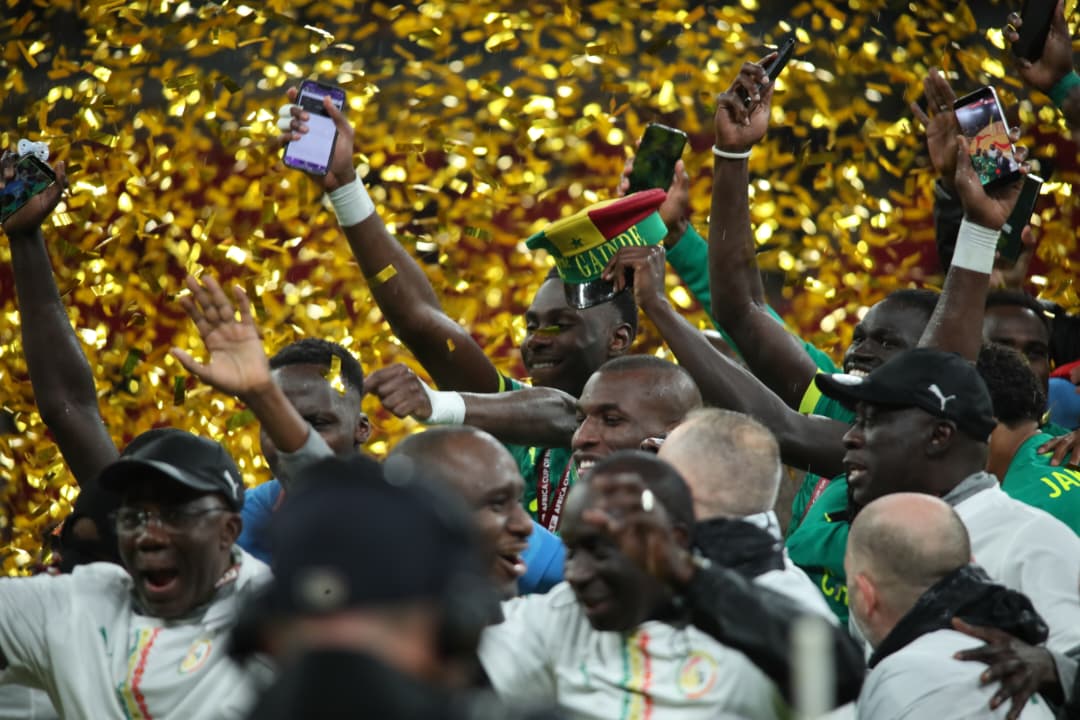
Two days after a night of extraordinary drama in Rabat, Senegal awakens to the glow of another African football triumph, a victory forged in adversity and crowned beneath a shower of gold.
The sky above the Prince Moulay Abdellah Stadium turned golden on Sunday night.

RABAT, MOROCCO – JANUARY 18: Senegalese player celebrate their dramatic 1–0 victory over Morocco on January 18, 2026, in Rabat, Morocco, in the 2025 Africa Cup of Nations final in Rabat, as golden “sky” confetti rains down and the Teranga Lions bask in the glory of their second continental crown. Photo by Ayoola Adeleke.
Confetti fell in sheets as Senegal’s players, staff and supporters erupted. Hands reached for the trophy. Phones rose into the air. Faces shone with disbelief and joy. In the middle of it all stood the Teranga Lions, champions of Africa once again.
Two days later, the images have not faded: Pape Gueye with his arms raised, Sadio Mané gathering his teammates close, and a glittering canopy overhead. But the final was no coronation. It was a night of tension, controversy and redemption, and Senegal had to dig deeper than skill to reach the summit.
The island that remembers
A few kilometres off the coast of Dakar lies Gorée Island, a small place of pastel-washed houses and narrow lanes that Senegal holds as one of its most solemn. UNESCO listed it as a World Heritage site in 1978. Its House of Slaves, with the doorway known as the Door of No Return, stands as a symbol of the Atlantic slave trade and of the people taken from Africa through it.
Gorée is a place about departure, and about what a nation does with its memory — Senegal stepped into independence in 1960 under Léopold Sédar Senghor, the poet-statesman who believed a young country could be defined by culture as much as power, and its story since has largely been one of turning memory into dignity. Its flag carries green, yellow and red, with a green star at the centre of the yellow stripe, the emblem of hope and aspiration.
RABAT, MOROCCO – JANUARY 18: Senegal players celebrate after winning the TotalEnergies Africa Cup of Nations (AFCON) 2025 final against Morocco at Prince Moulay Abdellah Stadium on January 18, 2026 in Rabat, Morocco. Photo by Ayoola Adeleke.
In Rabat, the golden confetti echoed that yellow stripe, a sky of light over a people who carry their history openly and still look up. And where Gorée’s doorway speaks of departures with no return, this night would turn on a return. The team’s name carries its own history too. Teranga, in Wolof, means hospitality, a value so woven into Senegalese life that the country is known as the land of Teranga. Yet the Lions who carried that name into Morocco needed more than warmth. They needed courage, discipline and a stubborn capacity to endure, the same qualities of a country that has long made a virtue of resilience.
Ninety minutes on the edge
Their opponents were Morocco, the hosts, backed by a roaring home crowd and a nation’s long wait for another continental crown.
From the opening whistle, Senegal looked determined to spoil the homecoming. Pape Gueye threatened from a corner. Iliman Ndiaye came close in a one-on-one with goalkeeper Yassine Bounou. Morocco stayed dangerous, pressing forward with the confidence of a side playing before its own people. As the minutes wore on, every tackle carried weight and every misplaced pass invited anxiety. The trophy hovered just beyond both teams.
Then came stoppage time, and everything unravelled.
Ismaila Sarr turned in a rebound, and Senegal thought they had won it, but the goal was disallowed for a foul. Moments later, Morocco were awarded a penalty after a VAR review. The stadium erupted. Senegal protested. On the instruction of coach Pape Thiaw, the players left the pitch.

RABAT, MOROCCO – JANUARY 18: Senegal’s Sadio Mane walks towards his teammates while holding the troManéafter winning the TotalEnergies Africa Cup of Nations (AFCON) 2025 final against Morocco at Prince Moulay Abdellah Stadium on January 18, 2026 in Rabat, Morocco. Photo by Ayoola Adeleke.
For several agonising minutes, the final seemed on the verge of collapse.
The captain’s call
It was Sadio Mané who stepped forward. He did not take a ball or a kick. He took on the harder task of persuading his teammates to come back. The veteran understood what the moment demanded: a trophy cannot be won from the tunnel.
They returned. In a country whose best-known doorway is the Door of No Return, the word carried a weight no commentator needed to spell out. Brahim Díaz stood over the penalty spot with history within reach and attempted a Panenka; Edouard Mendy refused to move, held his ground and caught the ball.
The silence at the stadium was deafening! Senegal had survived.
The golden strike
Extra time began with Senegal carrying the emotional force of a team that had escaped defeat. Mané won possession in midfield and found Idrissa Gana Gueye, who released Pape Gueye into space. The midfielder advanced, resisted the challenge of Achraf Hakimi and unleashed a magnificent left-footed strike into the top corner.

RABAT, MOROCCO – JANUARY 18: Senegal players wait for Sadio Mane as he approaches with the trophy following their victory over Morocco in the TotalEnergies Africa Cup of Nations (AFCON) 2025 final at Prince Moulay Abdellah Stadium on January 18, 2026 in Rabat, Morocco. Photo by Ayoola Adeleke.
The net rippled! It was a goal and an answer, a reply to the uncertainty and fear that had threatened to swallow the team minutes earlier. Morocco fought desperately to respond. Nayef Aguerd struck the crossbar with a header, and Senegal squandered chances to extend their lead, but the Lions held firm. When the final whistle came, the score read Senegal 1, Morocco 0. Players collapsed into one another. Pape Gueye was the hero of the night. Back home, supporters poured into the streets to celebrate a second AFCON crown.
More than a trophy
This victory belongs to a longer story. It stands for a generation that carried Senegal through the heartbreak of earlier finals to the heights of African football. The golden generation of 2002 first showed the country what it could be, reaching the continental final and then the World Cup quarter-finals. The title won at the 2021 tournament, lifted in early 2022, finally ended the long wait. Now, in 2026, the Lions have shown it was no accident.

RABAT, MOROCCO – JANUARY 18: Senegal players celebrate together after defeating Morocco in the TotalEnergies Africa Cup of Nations (AFCON) 2025 final at Prince Moulay Abdellah Stadium on January 18, 2026 in Rabat, Morocco. Photo by Ayoola Adeleke.
The golden sky above Rabat has become the defining image of that journey. From Gorée, where Senegal keeps its memory of loss, to a stadium where its players chose to come back, the country has shown that a nation shaped by its darkest chapters can still find light.
For the Teranga Lions, the night belonged to courage, the trophy belonged to Senegal, and the golden sky belonged to a nation that dared to dream again.